
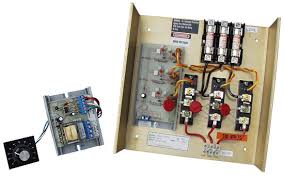
SCR Power Controls and Electric Heat
For more than 50 years, analog-based power supply designs have served industrial electric heating applications well. However, increasing demand for design flexibility, improved reliability, repeatability, and lower operating costs has made intelligent SCR power supplies an attractive alternative.
Intelligent SCR power supplies offer clear advantages over legacy analog designs. This article reviews the limitations of traditional analog power supplies and explains how intelligent SCR power control addresses those challenges for electric furnace and heating applications.
Data-Driven Performance
Intelligent power supply technology enables higher performance, increased productivity, and improved quality. At the core of an intelligent SCR power supply is a digital SCR power controller that combines:
- microcontroller-based processing
- Ethernet communications
- integrated I/O components
Unlike analog designs, intelligent power controllers offer flexible parameters that can be customized for specific applications. Proprietary algorithms and user-defined configurations are stored, recalled, and modified directly within the controller.
Key features include:
- hybrid firing modes for energy efficiency
- configurable nominal values, limits, and alarms
- embedded math functions and logic
- flexible I/O configurations
These settings can be defined through menu selection or built using a PC-based function block editor similar to those used in PLC environments.
An Ethernet port provides direct access to configurations, diagnostics, and process data that are not available with analog systems.
For regulation, the intelligent power supply is a superior choice. It compensates for load impedance and line voltage fluctuations by producing accurate voltage, current and power regulation. Hybrid firing techniques, load management and automatic transformer tapping produce energy efficiencies far beyond the reach of analog designs. Power factors between 92% and 98% may be achieved across the entire load curve.
A well-regulated process depends upon power control with high-accuracy feedback. Intelligent SCR supplies are digitally calibrated to traceable RMS voltage, current and power standards. Their calibrations hold true and are not affected by temperature, dust or other contaminants like manually calibrated devices.
With an intelligent SCR power supply, the furnace temperature is independent of electrical variations, because they are addressed by a self-regulating SCR power controller.
Improved Reliability
Analog power supplies have been reliably used for furnace applications for decades. One concern with replacing analog power supplies with intelligent technology is that of reliability. As with all custom designs, special consideration is given to the environment in which the power supply will be installed.
In dusty, corrosive or humid environments the power and control electronics are housed in enclosures with the appropriate NEMA or IP protection rating.
Adequate cooling is also critical. Typically:
- PLCs, HMIs, SCRs, and digital controls are installed on the control side of a compartmentalized enclosure
- transformers, tap switches, and high-power connections are installed on the power side
This separation improves cooling and protects against electrical interference.
In many cases, a custom intelligent SCR power supply can be installed in a footprint significantly smaller than its analog predecessor.
Reliability of an intelligent SCR power supply lies not only in its design but may be extended to include advanced diagnostics for heating elements. Condition monitoring helps eliminate downtime due to unexpected element loss.
Condition monitoring tracks element impedance across operating temperatures and known life cycles. As heating elements approach end of life, impedance increases and the system may no longer reach setpoint.
When this occurs, alarms are triggered early, allowing operators time to:
- order replacement parts
- schedule maintenance
- avoid unexpected downtime
Full and partial load alarms operate in a similar way. Normal load impedance is measured and stored. If a series or parallel element is lost, impedance increases by a known percentage.
If that threshold is exceeded, an alarm is issued. In constant power mode, the SCR power controller continues regulating output power within user-defined voltage and current limits while compensating for the lost element.
Lower Energy Costs
Energy efficiency is expressed in terms of power factor, which ranges between 0-100%. Intelligent power supplies reduce energy costs by employing power factor improvement techniques through hybrid firing. Hybrid firing modes produce much better power factors than analog designs. Additionally, peak kVA demand can be managed to avoid energy supplier demand penalties.
In many cases, these energy savings can provide a payback in as little as 2 years (depending upon energy rates).
As mentioned, unregulated analog power supplies are sensitive to changes in supply voltage or load impedance. SiC (silicon carbide) heating element resistance can have as much as 20% variation between new elements.
Additionally, element resistance can increase by over 300% across operating temperatures and/or over the life of the element. These variations in resistance compromise the performance of analog power supplies resulting in poor regulation and higher energy costs due to low power factor, THD (total harmonic distortion), core saturation, etc.
Mi2 (molybdenum disilicide) based heating elements can have significant resistance variation (up to 10x) between hot and cold temperatures. Current limitation is necessary to avoid damage to the elements or power supply. Intelligent power supplies can be designed to address resistance variations while maintaining the highest energy efficiency.
For example, in a typical MoSi2 application, the intelligent SCR can be configured in a pc-based function block editor for hybrid firing, which limits transformer magnetization and cold element inrush currents. As illustrated in Figure 4, the intelligent power supply first ramps the output towards the set point with phase angle firing and proportional current limit.
Unlike a fixed current limit, a proportional current limit is linear and follows the output as a percentage of the setpoint. As the impedance of the MoSi2 heating element increases with its temperature, the SCR output also increases. The intelligent SCR automatically transfers from current regulation mode to burst (zero-cross) firing and power regulation to promote the highest energy efficiency possible.
The case for intelligent SCR power controllers in electric heating applications is compelling.
Manufacturers face increasing pressure to reduce downtime, lower costs, and improve quality. Traditional analog power supplies no longer meet these demands.
Intelligent SCR power supplies deliver:
- higher reliability
- advanced diagnostics
- improved energy efficiency
- better process control
- reduced operating costs
With payback periods as short as two years, intelligent SCR technology also adds flexibility, connectivity, and data visibility to support modern production requirements.
This article was written by Stephen Kosik of Eurotherm.
If you have questions regarding Eurotherm products, give Sure Controls a call at 800-844-8405 or fill out a contact form online.