

Understanding the tradeoffs in flexibility, build time, customization and long-term adaptability
When designing a machine, automation cell or production system, choosing between modular aluminum framing and custom fabrication can have a significant impact on how the equipment is built, installed, modified and maintained over time. The frame may not be the most complex part of the project—but the way it is built can have a significant impact on everything around it.
Traditionally, welded steel and other custom-fabricated structures have been a go-to choice for industrial equipment. And for many applications, they remain the right solution. But modular aluminum framing offers another approach—one that can reduce fabrication requirements, simplify assembly and make future changes easier.
So, how do you decide which approach makes sense?
When Custom-Fabricated Machine Frames Make Sense
Custom fabrication offers nearly unlimited freedom in material selection, geometry and structural design. For applications with very high loads, unusual geometries, demanding environmental conditions or highly specialized requirements, a fabricated structure may be the best fit.
It can also make sense when equipment is designed for a very specific purpose and is unlikely to change throughout its operating life.
The tradeoff is that customization can add steps to the manufacturing process. Cutting, welding, drilling, machining, finishing and painting can all add time between design and final assembly. And once a welded structure is complete, making changes may require additional fabrication.
That becomes important when speed and adaptability are priorities.
Advantages of Modular Framing
Modular aluminum framing takes a different approach. Rather than fabricating a structure from scratch, engineers design around standardized extrusions, fasteners and components that can be configured for the application.
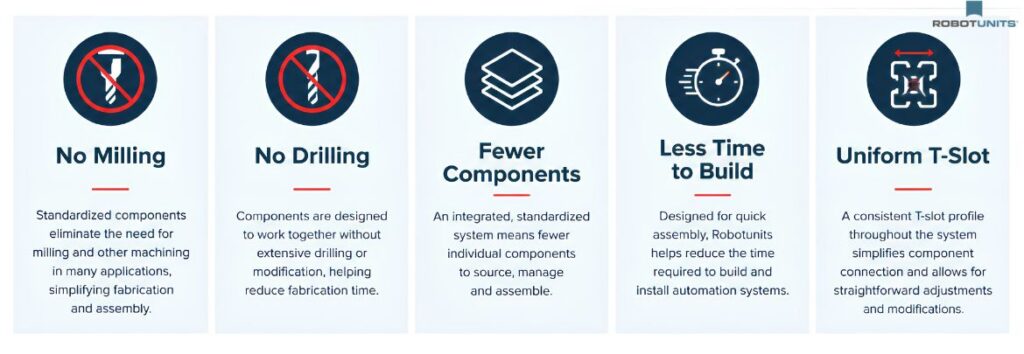
With the Robotunits Modular Automation System, for example, the same standardized T-slot is used throughout the extrusion system. Its fastening technology allows many structures to be assembled without the drilling and milling typically required with conventional extrusion systems.
That can translate into several practical advantages:
- Less fabrication. Reducing drilling, milling and welding can eliminate manufacturing steps.
- Fewer components. A standardized fastening approach can simplify the number of different components required.
- Faster assembly. Components can be cut, positioned and assembled without many secondary machining operations.
- Simpler modifications. Components can be repositioned, removed or added as requirements change.
- Greater standardization. A uniform T-slot and common component platform can simplify design across multiple pieces of equipment.
For manufacturers and machine builders working against tight timelines, those differences can add up.
Learn more about Robotunits conveyor and modular automation solutions from Sure Controls.
Think Beyond the Initial Build
One of the biggest differences between custom fabrication and modular framing may not show up during the initial installation.
It shows up later.
Production requirements rarely stay exactly the same. A new product may need to run on an existing line. A conveyor may need to be extended. Guarding may need to change. A workstation might be repositioned. A robot may be added. Or equipment originally designed for one process may need to support something entirely different.
With a permanently fabricated structure, those changes can mean cutting, welding, drilling, refinishing or replacing portions of the original equipment.
A modular structure is designed with change in mind.
Existing components can often be repositioned or reused, while additional components can be incorporated into the same system. Instead of treating every modification as another custom fabrication project, manufacturers have a platform they can continue to build upon.
That makes lifecycle flexibility an important consideration when comparing the two approaches.
Modularity Can Extend Beyond the Machine Frame
Machine framing is only one part of the mechanical infrastructure surrounding an automation system.
Conveyors move material into and out of equipment. Safety fencing and machine guarding protect operators. Workstations create interfaces between people and processes. Robot bases, linear motion components and other structures support the automation itself.
Using a common modular platform across these areas can help simplify the overall mechanical design.
The Robotunits system extends beyond aluminum extrusion to include conveyors, safety fencing and machine guarding, linear motion, machine frames, workstations, robot bases, gantries and other modular components.
Instead of approaching each piece as an isolated fabrication project, engineers can design more of the system around a standardized platform.
That can be particularly valuable when building automation that may need to expand or change over time.
Modular Aluminum Framing vs. Custom Fabrication: How to Choose
Neither approach is right for every application. When comparing modular aluminum framing with custom fabrication, consider the structural requirements of the application alongside project timeline, future modification needs, standardization and the surrounding automation system.
Custom fabrication may be the better fit when:
- Extremely high structural loads are involved
- Specialized materials or geometries are required
- Environmental conditions dictate a particular construction method
- The structure is highly application-specific
- Future modification is unlikely
Modular framing may be worth considering when:
- Project lead time is important
- Reducing machining and fabrication is a priority
- Equipment may need to change or expand
- Standardization across equipment is valuable
- Components may eventually need to be repositioned or reused
- Frames, conveyors, guarding and other structures need to work together
Ultimately, the decision shouldn’t come down to aluminum versus steel alone. It should start with how the equipment needs to perform—not just on installation day, but throughout its useful life.
Designing for What Comes Next
The best automation systems solve today’s production challenge without unnecessarily limiting tomorrow’s options.
For some applications, that means a purpose-built fabricated structure. For others, designing around a modular platform can reduce build effort today while providing more flexibility for future changes.
Not sure whether modular aluminum framing or custom fabrication is the better fit for your application? Sure Controls can help evaluate your structural, automation and future flexibility requirements and determine where a modular approach makes sense. Through our partnership with Robotunits, we can also help manufacturers implement modular mechanical solutions alongside the controls, robotics and automation technologies that make the system work.
From machine frames and conveyors to guarding, robot structures and complete automation systems, the goal is the same: build a solution that works for the application today—and is ready for what comes next.