
5 Manufacturing Challenges the Right Actuator Can Solve
Manufacturers are constantly pushed to increase throughput, lower downtime, and maintain tight product quality tolerances. While meeting these demands often feels like it requires expensive, full-scale machinery replacements, the solution isn’t always ripping and replacing an entire line. Often, upgrading a single critical component yields significant operational gains at a fraction of the cost.
One of the most frequent—and overlooked—sources of line inefficiency is physical motion.
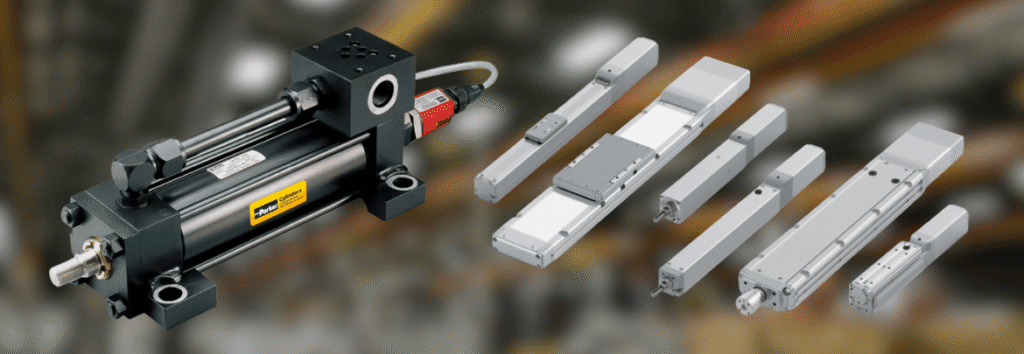
Whether positioning workpieces, operating flow control valves, setting machine guide rails, cycling safety guards, or indexing tooling, actuators drive the physical movement behind industrial automation. Matching the correct actuator technology to your specific load, speed, and environment eliminates production bottlenecks, boosts repeatability, and optimizes overall equipment effectiveness (OEE).
If your facility is facing any of the following operational hurdles, your motion control system may be due for an upgrade.
1. Manual Processes Are Throttling Throughput
Manual adjustments and repetitive operator tasks consume high-value production time. When technicians must physically reposition components, adjust manual cranks, cycle valves, or reconfigure tooling, overall cycle times balloon and human variability enters the process.
How the Right Actuator Solves It
Replacing manual levers, handwheels, and detents with automated motion control ensures tasks execute at maximum speed with zero operator variation.
- Pneumatic Actuators: Ideal for high-speed, cost-effective, two-position (point-to-point) tasks such as simple pushing, sorting, or clamping.
- Electric Actuators: Ideal when controlled acceleration, deceleration, and mid-stroke velocity management are needed to prevent product damage during high-speed transfers.
The Result:
- Faster line speeds and shorter cycle times
- Increased hourly unit throughput
- Optimized labor allocation toward higher-value tasks
2. Inconsistent Motion Is Driving Up Scrap and Rework
Even sub-millimeter variations in positioning lead to misaligned assemblies, incorrect dispense patterns, off-center stamping, and high scrap rates. In precision assembly, packaging, material handling, or inline inspection, mechanical drift or pressure fluctuations ruin quality control.
How the Right Actuator Solves It
Achieving strict process repeatability requires selecting a motion profile engineered for exact positioning tolerances:
- Electric Rod & Rodless Actuators: Powered by servo or stepper motors with integrated encoder feedback, electric actuators deliver precise closed-loop control with repeatability down to
.
- Elimination of Environmental Drift: Unlike air cylinders—which fluctuate with plant air pressure changes and thermal variance—electric motion systems maintain dead-on accuracy regardless of ambient shop-floor conditions.
The Result:
- Tightened positioning tolerances and sub-millimeter repeatability
- Uniform product quality across shifts
- Significant reduction in material waste and rework costs
3. Unplanned Downtime Is Destroying Plant Productivity
Unexpected component failures stop production, disrupt delivery schedules, inflate maintenance budgets, and sink profitability. In many plants, motion hardware fails prematurely because it was improperly specified for the application’s actual load, duty cycle, side-load capacity, or operating environment.
How the Right Actuator Solves It
Matching the right mechanical drive (ball screw, lead screw, belt drive, or pneumatic piston) to your load profiles dramatically extends mean time between failures (MTBF):
- Harsh Environments: Specifying actuators with proper ingress protection ratings (IP65/IP67 or stainless steel construction) protects internal mechanics against washdown chemicals, dust, and abrasive debris.
- High-Duty Cycles: Transitioning continuous-duty applications from fluid power to heavy-duty electric actuators avoids thermal breakdown, seal wear, and fluid leaks.
The Result:
- Higher overall equipment reliability (MTBF)
- Lower preventive maintenance overhead
- Maximized uptime and predictable maintenance schedules
4. Operator Safety Hazards Are Limiting Operational Efficiency
Requiring workers to perform repetitive manual tasks near moving pinch points, high-temperature zones, or hazardous chemical lines increases the risk of strain injuries and safety incidents. Safeguarding workers shouldn’t come at the expense of process speed.
How the Right Actuator Solves It
Automating hazardous or repetitive motion keeps personnel away from dangerous machinery while improving ergonomic compliance:
- Machine Guarding & Safety Interlocks: Actuators can automatically cycle safety doors, light-curtain barriers, and access gates in sync with machine cycles.
- Remote Flow Control & Heavy Lifting: Automating high-torque valve actuation or heavy load positioning removes technicians from extreme temperatures, chemical exposure, and ergonomics-related lift hazards.
The Result:
- Drastic reduction in repetitive-motion injuries (OSHA compliance)
- Enhanced operator safety without sacrificing line efficiency
- Fully automated, compliant safety barrier cycling
5. Lengthy Product Changeovers Are Creating Bottlenecks
High-mix, low-volume production requires short lead times and rapid changeovers. When changing product recipes requires technicians to manually reposition guide rails, readjust sensors, and swap mechanical hard stops, changeover times eat into daily production capacity.
How the Right Actuator Solves It
Multi-axis, programmable electric linear actuators simplify recipe adjustments into a one-touch operation:
- HMI Recipe Selection: Integrated fieldbus communications allow operators to trigger multi-axis positioning directly from the HMI.
- Automated Tooling & Rail Adjustments: Multi-position electric actuators move guide rails, tensioners, and tooling height settings to exact pre-programmed coordinates within seconds, completely eliminating manual measurement errors.
The Result:
- Drastic reduction in Mean Time to Changeover (MTTC)
- Immediate flexibility for high-mix, short-run production
- Higher Overall Equipment Effectiveness (OEE)
Motion Is More Than Movement—It’s Your Competitive Advantage
Every physical movement across your plant floor directly impacts cycle speed, product quality, maintenance overhead, and workplace safety. Upgrading an underperforming motion component is often the most cost-effective capital investment you can make to unlock hidden plant capacity.
Whether you are retrofitting an aging production line, upgrading OEM machinery, or specifying components for a new automation system, analyzing your motion profiles will reveal significant opportunities to lower operating costs and boost throughput.
How Sure Controls Helps You Optimize Motion
At Sure Controls, our automation engineers don’t just sell components—we help you solve complex application challenges. We evaluate your complete operating environment, duty cycle requirements, force/speed profiles, and control network protocols to specify the exact actuator technology for your goals.
Ready to eliminate motion bottlenecks in your plant?
Contact the Sure Controls Engineering Team Today to schedule an application review and discover how the right actuator solution can improve your plant’s efficiency, reliability, and profitability.