
Infrared (IR) temperature sensors are indispensable tools in modern industry, healthcare and research. They offer the ability to measure surface temperature without any physical contact, which is invaluable when dealing with fragile electronics, molten metals, rotating machinery or contamination‑sensitive materials. This article explains how IR temperature sensors work, highlights their advantages and applications, compares analog and digital models, and provides guidance on choosing the right sensor for your needs.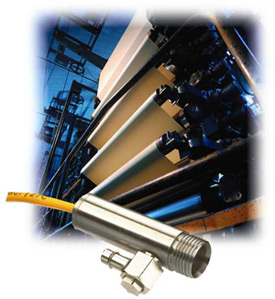
Shop Sure Controls infrared temperature sensors today!
What Is an IR Temperature Sensor?
An IR temperature sensor (sometimes called an infrared thermometer or non‑contact temperature sensor) measures an object’s surface temperature by detecting the infrared radiation emitted by that object. Infrared radiation is electromagnetic energy with wavelengths just below visible light; it is invisible to the human eye but perceived as heat. The sensor’s optical system collects this radiation and focuses it on a thermopile (a series of thermocouples) and a thermistor, which generate a voltage proportional to the thermal energy. Modern digital IR sensors integrate these components with an application‑specific integrated circuit (ASIC) that amplifies, linearizes, and digitizes the signal.
In simple terms, an IR sensor reads the amount of heat radiated by the target, converts it into an electrical signal and translates that into a temperature reading. Because it does not need to touch the object, it is ideal for measuring extremely hot, moving or inaccessible surfaces, as well as items that must remain sterile or uncontaminated.
The 8–14 μm wavelength window
Most industrial IR temperature sensors operate in the 8–14 μm wavelength band. This window corresponds to the peak emission of many common materials and is less affected by atmospheric absorption. For example, Renke’s industrial IR sensors detect infrared radiation in the 8 μm to 14 μm range and accurately calculate surface temperature.
How Do IR Temperature Sensors Work?
While the basic principle remains the same across models, the electronics and calibration methods vary. Two main categories are analog and digital sensors:
Feature | Analog IR sensor | Digital IR sensor |
Signal processing | Uses a thermopile and a thermistor connected to external circuits. Requires system‑level calibration and an analog‑to‑digital converter (ADC) to digitize the signal. | Integrates a thermopile, a thermistor, and an ASIC that conditions and digitizes the signal. Factory‑calibrated; outputs a digital I²C or RS‑485 signal. |
Calibration | Must be calibrated by the user. | Factory‑calibrated to ±1 °C at 25 °C, with built‑in ambient temperature compensation. |
Ease of integration | Requires external electronics and calibration expertise. | Plug‑and‑play simplifies integration into systems. |
Advantages of Infrared Temperature Sensors
Non‑contact measurement
Contact-based temperature sensors do not work well on moving objects. Infrared temperature sensors are ideally suited for measuring the temperatures of tires, brakes, and similar devices.
Infrared temperature sensors don’t wear.
No contact means no friction. Infrared sensors experience no wear and tear and consequently have longer operating lives.
Infrared temperature sensors can provide more detail.
An IR sensor can provide greater detail during a measurement than contact devices simply by pointing it at different spots on the object being read.
IR temperature sensors can detect motion by measuring fluctuations in temperature in the field of view.
Adaptability
Many sensors offer adjustable emissivity settings, laser aiming devices, digital displays and cooling jackets to adapt to different measurement environments. Accessories improve accuracy and ease of use.
Reduced contamination
In food processing or pharmaceutical manufacturing, non‑contact measurement avoids cross‑contamination and preserves sterility.
Key Specifications and What to ConsiderOrdering a Sensor
Choosing the right IR temperature sensor requires evaluating several parameters:
- Temperature range: Ensure the sensor covers your expected temperatures. Industrial ranges can extend from –30 °C to 1,200 °C, but specialized models exist for narrower ranges or human body measurement (e.g., 28–45 °C for medical thermometers).
- Accuracy and calibration: Digital sensors factory‑calibrated to ±1 °C are suitable for precise control. Analog sensors may require user calibration.
- Response time: Fast response (e.g., 150–300 ms) is important in dynamic processes. Determine if your application needs instantaneous readings or slower averaging.
- Distance‑to‑spot ratio: This defines how far the sensor can be from the target while maintaining accuracy. A 20:1 ratio means that at 20 cm distance, the sensor measures a 1 cm diameter spot. Ensure your target completely fills the sensor’s field of view.
- Emissivity: Different materials emit infrared energy differently. Organic materials generally have high emissivity (close to 0.95) while shiny metals have low emissivity, which can lead to measurement errors. Choose a sensor with adjustable emissivity or apply a high‑emissivity coating on metal surfaces.
How to Choose the Right IR Temperature Sensor
- Define your temperature measurement task. Determine the highest and lowest temperatures you need to measure and the size of the objects. Choose a sensor with a suitable range (–30 °C to 600 °C for general industrial use or up to 1,200 °C for metallurgical applications).
- Consider accuracy requirements. If you need better than ±1 °C accuracy, select a sensor with factory calibration and ambient temperature compensation. For process control, relative changes might be more important than absolute accuracy.
- Match the distance‑to‑spot ratio. Ensure that at your working distance, the sensor’s spot size covers only the target. For small targets, choose sensors with high optical resolution (e.g., 20:1 or higher).
- Account for emissivity. If you measure shiny or low‑emissivity surfaces, select a sensor with emissivity adjustment or plan to coat the surface with non‑reflective paint or tape. High‑temperature paints or emissivity stickers can help calibrate measurements.
- Select the appropriate output type. For simple analog control loops, 4–20 mA outputs may suffice. For digital integration with PLCs or microcontrollers, choose sensors with I²C or RS‑485 outputs. Consider whether you need alarm functions or data logging.
- Evaluate the sensor’s environment. Ensure the housing material and IP rating can withstand heat, moisture, or dust. For hot environments, choose sensors with cooling jackets.
- Look at accessories and installation. Laser sights help aim at small targets, while digital displays provide immediate readouts. Evaluate mounting options such as threaded interfaces or adjustable brackets for secure installation.
- Seek expert advice. If you’re unsure which model suits your process, consult an application engineer. Sure Controls offers personalized assistance to help match you with the ideal IR sensor.
Problems When Measuring with Infrared Temperature Sensors
IR temperature sensors can be confused by background sources of infrared radiation when used as motion detectors. You can work around this problem by using the differential detection technique. To do this, wire two sensors to a differential amplifier as opposite inputs. When wired like this, the sensors cancel out the average temperature of their shared field of view. Any fluctuations in background temperature will not be able to trigger a motion reading. This arrangement also reduces common-mode interference. Note that this technique only works for motion detection, not temperature reading.
To deal with the problem of background heat when measuring temperature, as opposed to motion detection, narrow the sensor’s field of view so that it is constrained entirely to the object being measured. If it is impractical to do this directly, then use plastic shields to block out background elements in the sensor’s field of view.
Call the Sure Controls team at 800-844-8405 or contact us online for more information on infrared temperature sensors.
Frequently Asked Questions
What is the working principle of an IR temperature sensor?
An IR temperature sensor measures the infrared radiation emitted by an object, typically in the 8–14 μm wavelength range. The energy is focused onto a thermopile and converted into a voltage, which is processed (often by an ASIC) and output as temperature.
How accurate are IR temperature sensors?
Accuracy depends on the model. Digital sensors may be factory‑calibrated to ±1 °C at 25 °C with built‑in ambient temperature correction. Accuracy decreases at extreme temperatures or when emissivity is mis‑set. Regular calibration and proper setup improve accuracy.
What temperature range can they measure?
Industrial IR sensors can cover –30 °C to 1,200 °C. Some specialty models focus on narrow ranges (e.g., 28–45 °C for medical use). Always match the sensor’s range to your application.
Can IR sensors measure internal temperature?
No. IR sensors measure only surface temperature. They cannot see through glass or liquid and cannot measure internal temperatures inside an object. For internal readings, use contact probes or thermocouples.
What are typical applications of IR temperature sensors?
They are used in manufacturing, metallurgy, food processing, HVAC, healthcare and automotive industries. Their non‑contact nature makes them ideal for measuring moving, hazardous or delicate objects.
How should I maintain an IR temperature sensor?
Keep the lens clean, avoid exposing the sensor to harsh chemicals, and check calibration periodically. Use protective housings or cooling jackets if the sensor operates in extreme temperatures.