
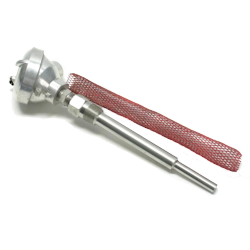
What Is the Difference Between an RTD and a Thermocouple?
Resistance Temperature Detectors (RTDs) and thermocouples are two of the most widely used temperature sensors in industrial automation. While both measure temperature, they operate using different principles and each is better suited for specific applications.
In general, RTDs are the preferred choice when accuracy, stability, and repeatability are most important, while thermocouples excel in high-temperature and rugged industrial environments where durability and fast response times are critical.
Understanding the differences between RTDs and thermocouples—including their accuracy, temperature range, response time, and cost—can help you select the right sensor for your application.
RTD vs. Thermocouple Comparison
Feature | RTD | Thermocouple |
Accuracy | Excellent | Good |
Temperature Range | Up to approximately 1,000°F | Up to approximately 2,700°F |
Response Time | Moderate | Fast |
Cost | Higher | Lower |
Durability | Good | Excellent |
Long-Term Stability | Excellent | Good |
Best For | Precision temperature measurement | High-temperature industrial applications |
How Does an RTD Work?
The electrical resistance of metals rises as heat increases and the metals become hotter, while their electrical resistance falls as heat decreases and the metals become colder. RTDs are temperature sensors that use the changes in the electrical resistance of metals to measure the changes in the local temperature. For the readings to be interpretable, the metals used in RTDs must have electrical resistances known to people and recorded for convenient reference. As a result, copper, nickel, and platinum are all popular metals used in the construction of RTDs.
The most prevalent configuration, the PT100 RTD, is defined by having 100 ohms of resistance at 0°C and provides a highly linear and predictable response.
RTDs are available in multiple wiring formats, often referred to as two-wire, three-wire, or four-wire RTD line configurations, allowing the sensor to compensate for lead-wire resistance depending on installation requirements.
Because RTDs provide highly accurate and repeatable measurements, they are commonly used in industries such as food and beverage, pharmaceuticals, HVAC, and precision manufacturing where consistent temperature control is essential.
How Does a Thermocouple Work?
Thermocouples are temperature sensors that use two different metals in the sensor to produce a voltage that can be read to determine the local temperature. Different combinations of metals can be used in building the thermocouples to provide different calibrations with different temperature ranges and sensor characteristics.
Their simple construction and broad compatibility make them a common alternative to RTD temperature sensing where extreme conditions are present.
Thermocouples are commonly used in furnaces, kilns, heat treating, exhaust systems, and other applications where sensors must withstand extreme temperatures or harsh operating conditions.
Download the Sure Controls thermocouple design sheet for more information.
RTD vs. Thermocouple: Key Differences
Accuracy
RTDs generally provide greater accuracy and repeatability than thermocouples. Their stable electrical resistance makes them well suited for applications where precise temperature measurement is critical.
Temperature Range
Thermocouples offer a much wider operating temperature range. While most RTDs are limited to approximately 1,000°F, certain thermocouple types can accurately measure temperatures up to approximately 2,700°F.
Response Time
Because thermocouples have a simpler construction, they typically respond faster to rapid temperature changes than RTDs.
Durability
Thermocouples are generally more resistant to vibration, shock, and harsh industrial environments, making them a popular choice for demanding applications.
Cost
Thermocouples typically cost less than RTDs. Although RTDs can have lower installation costs in some applications, thermocouples often provide the lower overall equipment cost.
When Should You Use an RTD?
An RTD is typically the best choice when your application requires:
- High measurement accuracy
- Excellent long-term stability
- Repeatable temperature readings
- Moderate operating temperatures
- Tight process control
Typical RTD applications include pharmaceutical manufacturing, food processing, laboratory equipment, HVAC systems, and industrial process control.
When Should You Use a Thermocouple?
Thermocouples are often preferred when your application requires:
- Extremely high operating temperatures
- Fast response times
- Rugged construction
- Lower sensor cost
- Operation in harsh industrial environments
Common applications include furnaces, ovens, kilns, foundries, engines, and heat treatment processes.
How to Identify an RTD vs. a Thermocouple
Although RTDs and thermocouples can appear similar, there are several ways to distinguish between them.
- RTDs commonly use two-, three-, or four-wire configurations, while thermocouples typically use two wires made from dissimilar metals.
- Many RTDs are labeled PT100 or PT1000, indicating the sensing element used.
- Thermocouples generate a small voltage signal, while RTDs measure changes in electrical resistance.
- Wire colors may also help identify the sensor type, although color coding varies depending on the standard being used.
If you’re unsure which sensor you have or which one is best for your application, the Sure Controls team can help.
Conclusion
There isn’t a one-size-fits-all answer when comparing RTDs and thermocouples. The best choice depends on your application’s operating temperature, required accuracy, environmental conditions, and budget.
If precise, stable temperature measurements are your priority, an RTD is often the better option. If your application involves extreme temperatures or harsh environments, a thermocouple may be the better fit.
Need help selecting the right temperature sensor? Contact the experts at Sure Controls to discuss your application and find the best solution for your process.
Related Temperature Solutions
You may also be interested in:
Have questions? Fill out our contact form and a skilled Sure Controls professional will be in touch.
Check out all of our thermal sensors
Looking For Industrial Automation Parts? We Can Help!